Example board · Actuarial science
The chain-ladder method
A revision board made in MySummaries for short-term actuarial mathematics, shown as the app shows it in study mode. Updated 27 September 2026.
Highlights: the idea a number to know what to do, or the formula a trap
Loss reservingThe chain-ladder method10 sections · 3 columns
Chain ladder on a paid triangle ($000)
| Accident year | 12 mo | 24 mo | 36 mo | 48 mo | 60 mo | CDF | Ultimate | Reserve |
|---|---|---|---|---|---|---|---|---|
| 2021 | 908 | 1,731 | 2,106 | 2,248 | 2,288 | 1.000 | 2,288 | 0 |
| 2022 | 982 | 1,794 | 2,221 | 2,378 | 2,421 | 1.018 | 2,421 | 43 |
| 2023 | 1,042 | 1,844 | 2,303 | 2,462 | 2,506 | 1.088 | 2,506 | 203 |
| 2024 | 1,049 | 2,005 | 2,476 | 2,647 | 2,695 | 1.344 | 2,695 | 690 |
| 2025 | 1,133 | 2,098 | 2,591 | 2,770 | 2,820 | 2.489 | 2,820 | 1,687 |
| Age-to-age | 1.852 | 1.235 | 1.069 | 1.018 | 1.000 tail | |||
| Total | 12,730 | 2,623 |
What it estimates
- Ultimate: what an accident year's claims finally cost, once every claim is settled
- Paid to date = the latest diagonal
- Reserve = ultimate − paid to date: case reserves + IBNR
Which average?
- 12–24 link ratios: 1.906, 1.827, 1.770, 1.911
- All years: simple 1.854, volume-weighted 1.852
- Latest 3 years, volume-weighted: 1.836
- Volume-weighted is sum over sum, so big years count for more
- Use the average the question names: all years, latest 3, excluding high and low
Paid or incurred?
- Incurred (reported) = paid + case reserves
- IBNR = ultimate − incurred, not ultimate − paid
- Paid: slower and more leveraged, but case-reserve changes don't touch it
- Incurred: develops faster, but moves with case-reserve adequacy
Bornhuetter–Ferguson, next
- For immature (green) years, lean on an expected loss ratio (ELR) instead
- Ult = paid + ELR × premium × (1 − 1/CDF)
- 2025: 59.8% still to pay
- As a year matures, 1/CDF → 1 and BF converges on the chain ladder
Known and projected
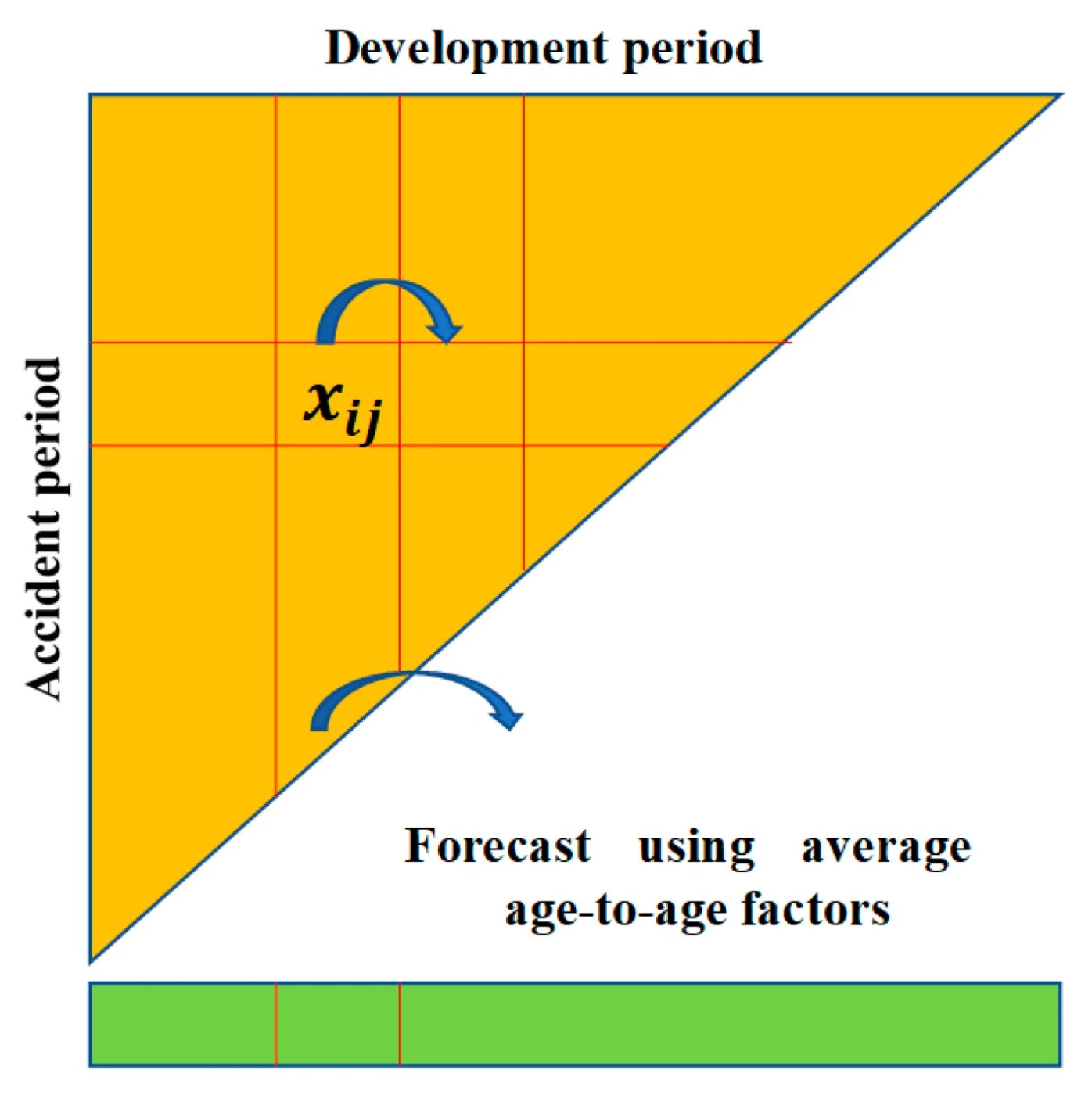
Step by step
- Cumulative paid in a triangle: accident years down, ages across
- Link ratios → average them → select a factor for each age
- Choose a tail for development past 60 months: 1.000 here
- Multiply from each age to ultimate: the CDF
- Ultimate = latest diagonal × CDF; applying the factors in turn fills the italic cells
- Reserve = ultimate − paid to date, summed over the years
The formulas
- : cumulative paid, accident year , age
- Both sums over the same years: leave out the year with no yet
- = share of ultimate paid by age
- Ultimate
Worked example: 2025
- (2021–2024 only)
- CDF:
- Ultimate: 2,820
- Reserve: 1,687 → 60% still unpaid
Assumptions and traps
- Key assumption: the future develops like the past
- Changes in claims handling, settlement speed, inflation or mix break it
- The latest year is heavily leveraged: × 2.489 amplifies any noise in its 1,133
- A tail of 1.000 says nothing develops after 60 months
Make your own board. Build a board of your own from your notes, and MySummaries writes the flashcards, practice papers and audio lectures from it. Free plan: 20 cards, a paper, a lecture and a viva to try.
Make your own board