Example board · Aviation
Stalls and load factor
A revision board made in MySummaries for CPL theory, shown as the app shows it in study mode. Updated 30 September 2026.
Highlights: the idea a number to know what to do, or the formula a trap
AerodynamicsStalls and load factor12 sections · 3 columns
Bank, load factor and the turn
| Bank | Load factor, 1/cos φ | Stall speed, × √n | A 50 kt stall becomes | Rate of turn at 100 kt | Radius at 100 kt |
|---|---|---|---|---|---|
| 0° | 1.00 | — | 50 kt | — | straight |
| 15° | 1.04 | +2% | 51 kt | 2.9°/s | 1,007 m |
| 30° | 1.15 | +7% | 54 kt | 6.3°/s | 467 m |
| 45° | 1.41 | +19% | 59 kt | 10.9°/s | 270 m |
| 60° | 2.00 | +41% | 71 kt | 18.9°/s | 156 m |
| 75° | 3.86 | +97% | 98 kt | 40.8°/s | 72 m |
The stall
- A wing stalls at its critical angle of attack, not at a speed
- Past it the flow separates over the top and lift falls away
- Any airspeed, any attitude, any weight
- : at the stall is at its maximum, so more lift needs more speed
- On the chart: at about 20°, then the drop
Where the wing stalls first
- The root, ideally, so the ailerons keep working through the stall
- Rectangular: root first. Tapered or swept: tip first
- Washout: less incidence at the tip, so the root reaches critical first
- Stall strips at the root; slots or slats near the tips
The warnings
- Buffet: the separated flow shakes the airframe
- The stall warner, a horn or a light, a few knots before the stall
- Soft controls, a high nose attitude, a decaying airspeed
- Ice on the wing: it can stall before the warner sounds
Spin or spiral dive?
- Spin: stalled, the airspeed low and steady, the rotation steady
- Spiral dive: not stalled, the airspeed and g climbing fast
- Spin recovery: PARE, power idle, ailerons neutral, rudder opposite, elevator forward
- Spiral recovery: power off, roll the wings level, then ease out of the dive
Lift, drag and the stall
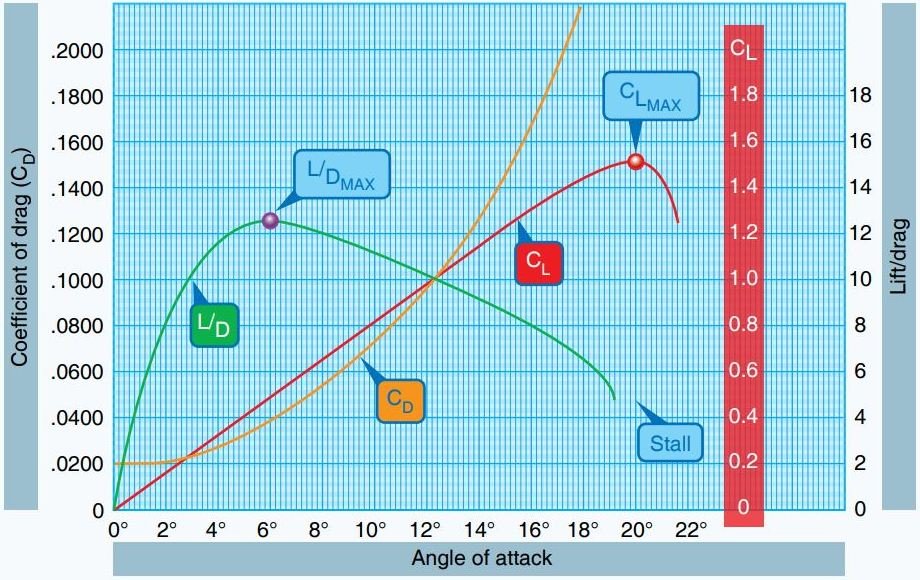

The stalls you practise
- Power-off: the approach, flap and gear down, low and slow
- Power-on: the climb-out at full power; propeller yaw makes a wing drop likely
- Accelerated: above , in a steep turn or an abrupt pull-up
- Cross-control: a skid, rudder into the turn and aileron against it
- Elevator trim: a go-around with nose-up trim set; full power pitches the nose up
- Secondary: pulling out of a recovery before flying speed is back
Recovery and traps
- Unload first: lower the angle of attack, then level the wings, then power
- Skidding base-to-final turn: the inside wing stalls first, a spin entry
- A level 75° turn pulls 3.86 g: past a normal-category airframe's 3.8 g
- The arcs are 1 g stall speeds: in a turn the stall comes sooner
What else moves the stall speed
- Weight: 10% lighter, about 5% lower ()
- Flap: lower, from a higher , but it stalls at a smaller angle
- Forward CG: higher, since the wing also carries the tail's down-force
- Ice or frost: higher, and at a smaller angle of attack
- Altitude: about the same indicated airspeed; the true airspeed is higher
In a level turn
- Coordinated and level: n = 1/cos φ, and
- 60° of bank: 2.00 g, and a stall 41% faster
- 30° costs only 7%; 45°, 19%
- Rate one, 3°/s, is a full circle in 2 minutes: bank ≈ TAS/10 + 7 (100 kt: 17°, exactly 15°)
- Rate and radius depend on bank and TAS alone: weight changes neither
- More bank, more back pressure: the angle of attack creeps towards critical
On the ASI
- Bottom of the white arc, : the stall in landing configuration
- Bottom of the green arc, : the stall clean
- Top of the white arc, : the most with flap extended
- Red line,
Manoeuvring speed
- : full, abrupt control stalls the wing before it overstresses the airframe
- : at +3.8 g, 1.95 times
- Limit loads: normal +3.8/−1.52 g, utility +4.4/−1.76 g, aerobatic +6.0/−3.0 g
- Lighter means lower: falls with weight
Make your own board. Build a board of your own from your notes, and MySummaries writes the flashcards, practice papers and audio lectures from it. Free plan: 20 cards, a paper, a lecture and a viva to try.
Make your own board