Example board · Psychology
Models of memory
A revision board made in MySummaries for cognitive psychology, shown as the app shows it in study mode. Updated 1 October 2026.
Highlights: the idea a number to know what to do, or the formula a trap
MemoryModels of memory11 sections · 3 columns
The key studies
| Study | Method | Found | Shows | But |
|---|---|---|---|---|
| Sperling (1960) | A 3 × 4 letter grid for 50 ms; a tone cued one row | About 3 of the cued row’s 4 | Iconic memory holds most of it, under 1 s | Artificial stimuli |
| Miller (1956) | A review of span studies | 7 ± 2 items; chunking stretches it | STM capacity is limited | Cowan (2001): 4 ± 1 chunks |
| Peterson and Peterson (1959) | Trigrams, then counting back in threes | About 80% at 3 s, under 10% at 18 s | Unrehearsed STM lasts 18–30 s | Interference, not only decay (Keppel and Underwood, 1962) |
| Baddeley (1966) | Lists that sound alike or mean alike | Sound hurt STM; meaning hurt LTM | STM acoustic, LTM semantic | Word lists only |
| Glanzer and Cunitz (1966) | Free recall, with a 30 s delay | The delay removed recency, not primacy | Two separate stores | Unrelated words |
| Bahrick et al. (1975) | 392 graduates and their yearbook photos | About 90% at 15 years, about 70% at 48 | LTM lasts a lifetime | Rehearsal uncontrolled |
| Shallice and Warrington (1970) | Case study of KF | Poor verbal STM; visual STM intact | STM is not one store | One patient |
The multi-store model
- Atkinson and Shiffrin (1968): the senses feed the sensory register
- What we pay attention to passes into short-term memory
- Maintenance rehearsal keeps it there, and enough of it moves it to LTM
- Retrieval brings a long-term memory back into STM
- Unattended, unrehearsed or displaced, it is lost
Evidence for working memory
- Dual tasks: two on the same component interfere; on different ones, not
- Word-length effect: span holds about 2 s of speech (Baddeley, Thomson and Buchanan, 1975)
- Saying "the the the" removes it
- The central executive is the vaguest part: named, hardly measured
Types of long-term memory
- Episodic: personal events, time-stamped (Tulving, 1972)
- Semantic: facts and meanings
- Procedural: skills, recalled without awareness (Cohen and Squire, 1980)
- Knowing that against knowing how
- HM learned mirror drawing but did not remember practising
The three stores
- Sensory register: very large; iconic under 0.5 s, echoic 2–4 s
- STM: 7 ± 2 items, 18–30 s, mainly acoustic
- LTM: unlimited, up to a lifetime, mainly semantic
- Jacobs (1887): mean span 9.3 digits, 7.3 letters
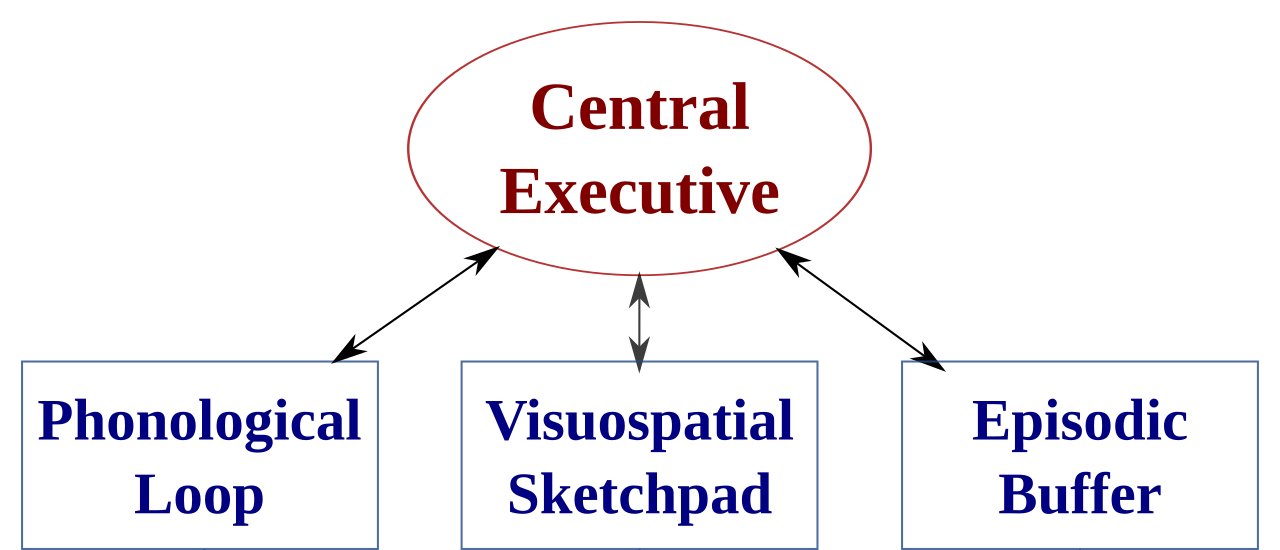
Working memory (Baddeley and Hitch, 1974)
- Central executive: directs attention; stores nothing
- Phonological loop: phonological store (inner ear) and articulatory control process (inner voice)
- Visuo-spatial sketchpad: the inner eye
- Episodic buffer, added in 2000: binds the others and LTM
Forgetting: interference
- Proactive: old learning disrupts new
- Retroactive: new learning disrupts old
- Worst when similar: synonyms interfered most (McGeoch and McDonald, 1931)
- It says nothing about why cues help
Forgetting: retrieval failure
- Encoding specificity: a cue works if it was there at learning (Tulving and Thomson, 1973)
- Divers recalled about 40% less in a different place (Godden and Baddeley, 1975)
- State: an antihistamine’s drowsiness was a cue (Carter and Cassaday, 1998)
Evaluating the multi-store model
- For: the serial position curve, KF and HM, the coding and duration studies
- STM is not one store: KF lost verbal STM but not visual
- Nor is LTM: episodic, semantic and procedural come apart
- Depth of processing matters more than rehearsal (Craik and Watkins, 1973)
Working memory

Exam traps
- Capacity is how much; duration is how long
- Miller (1956) was a review, not an experiment
- Baddeley (1966) is about coding, not capacity
- Evaluate with a named study for every strength and weakness
Make your own board. Build a board of your own from your notes, and MySummaries writes the flashcards, practice papers and audio lectures from it. Free plan: 20 cards, a paper, a lecture and a viva to try.
Make your own board