Study from your own notes.
Drop in PDFs, Word documents, photos of your notes — handwriting included — or a lecture recording. MySummaries organises them into boards, then writes the flashcards, mock papers, audio lectures and viva questions from them, and marks your answers against them.
Any subject you have notes for. Free plan — no payment details, and nothing expires.
| Vessel | Wall | Pressure | Job |
|---|---|---|---|
| Elastic artery | Thick, elastic | High, pulsing | Smooths each beat into steady flow |
| Arteriole | Thick smooth muscle | Falls most steeply | Resistance — TPR is set here |
| Capillary | One cell thick | Low, steady | The exchange surface |
| Vein | Thin, distensible | Lowest | Holds about two-thirds of the blood |
- Systole — the AV valves shut at S1; then ejection
- Diastole — the semilunar valves shut at S2; then filling
- Atrial kick — the atria contract, adding the last fifth of filling
- Preload — the stretch on the ventricle at the end of diastole, which venous return sets
- Afterload — the pressure the ventricle ejects against
Heart rate times stroke volume, at rest. Hard exercise takes it past 20 L/min.
Stretch means slow down — the carotid sinus and aortic arch report pressure; a rise adds vagal tone and cuts sympathetic outflow within seconds.
More stretch, stronger beat — a fuller ventricle stretches its fibres and contracts harder, so the heart pumps out what venous return brings in.
| Source | Effect |
|---|---|
| SA node | On its own, about 100 a minute |
| Vagus | Slows it to about 70 at rest |
| Sympathetic | Faster, stronger beats |
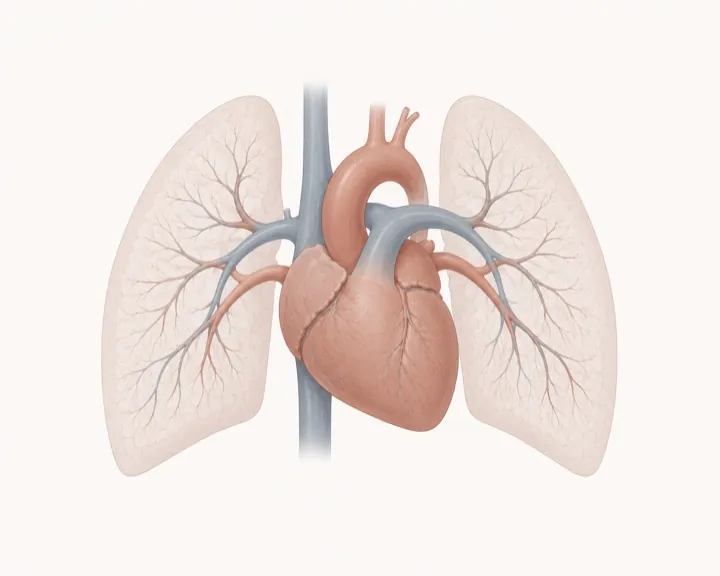
The SA node fires first — the impulse spreads over the atria, and the AV node holds it about 0.1 s so they finish contracting; His–Purkinje fires the ventricles.
Squeezed back to the heart — working leg muscles and each breath in push blood back to the heart; valves in the limb veins stop it running back.
Brain, heart and kidney keep their own blood flow steady while mean pressure moves across a wide range: their arterioles narrow as it rises and widen as it falls.
12 — leads in a standard ECG recording; 10 — electrodes they are taken from; 25 — millimetres of paper a second.
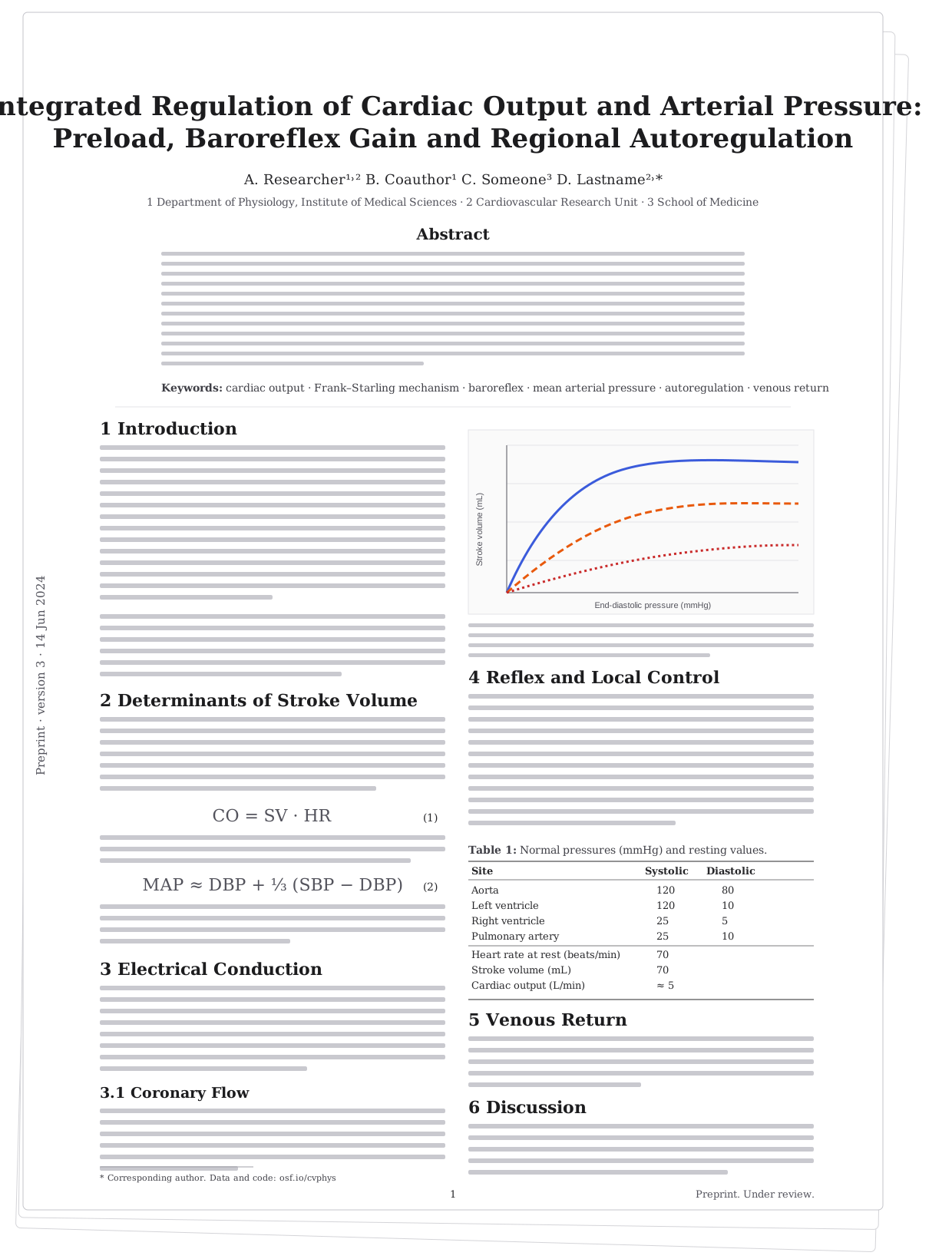
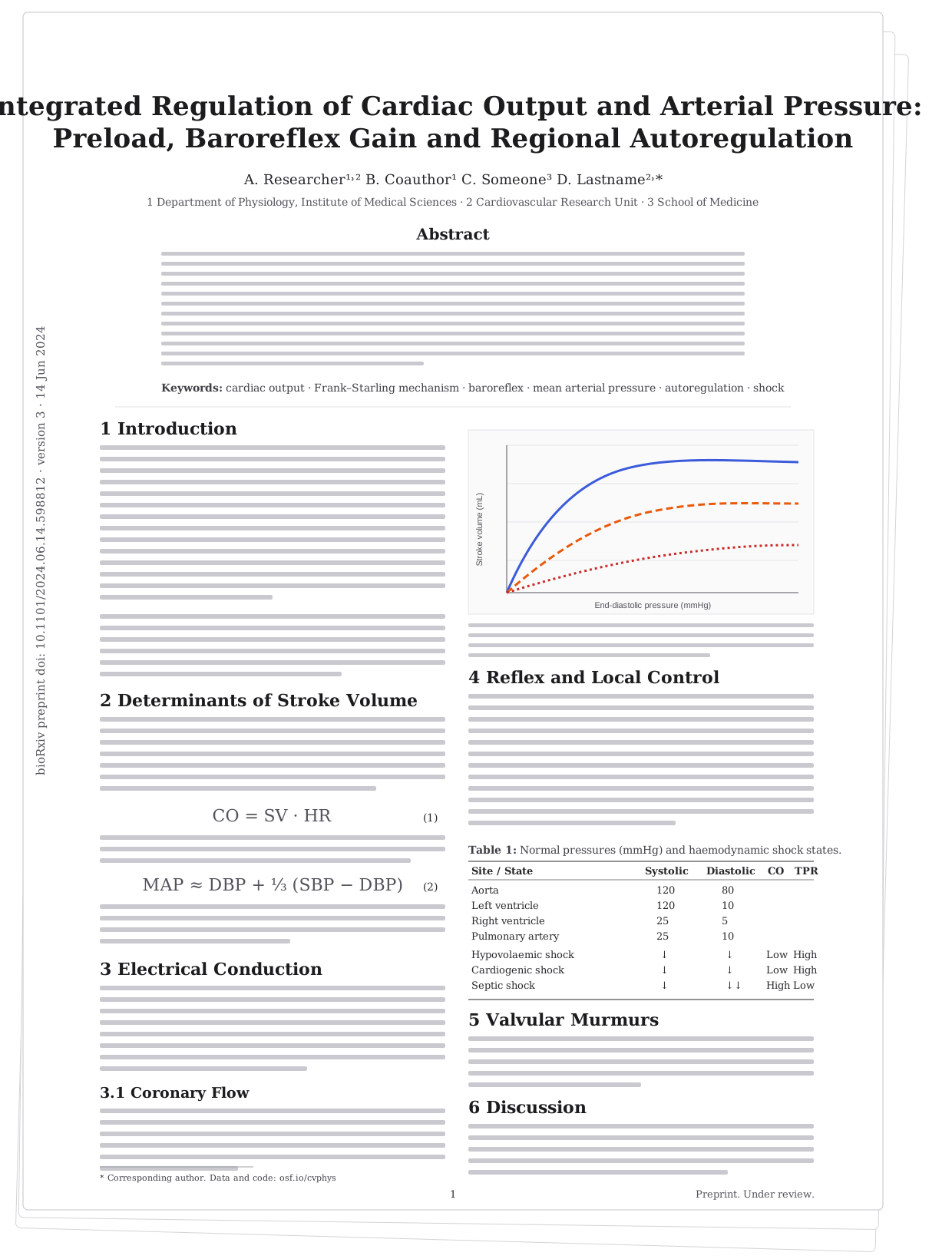
Mean arterial pressure is diastolic plus a third of the pulse pressure, so 120/80 gives a mean of about 93 mmHg.
| Site | mmHg |
|---|---|
| Aorta | 120/80 |
| Left ventricle | 120/10 |
| Right ventricle | 25/5 |
| Pulmonary artery | 25/10 |
| Wave | Shows | Then |
|---|---|---|
| P | Atria depolarise | Atria contract |
| QRS | Ventricles depolarise | Ventricles contract |
| T | Ventricles repolarise | Ventricles relax |
The heart feeds itself through the coronary arteries. The left one fills mostly in diastole, because in systole the contracting wall squeezes its vessels.
preload = stretch at end diastole,, afterload - pressure it has to overcome??
- Preload — end-diastolic stretch
- Afterload — pressure it must overcome
What makes the first and second heart sounds?
S1 is the AV valves shutting; S2 is the aortic and pulmonary valves shutting.
Two lost marks became cards. They're waiting in your tray.
…filling is passive until the atrial kick tops up the ventricle…
Talk me through one cardiac cycle and its two heart sounds.
Made from your notes.
Every card, paper, lecture and viva question is generated from your own board — and marked against it. What you study is what you wrote.
Nothing comes from a generic question bank. The material is yours.
Say what you're studying, and the marker is set up for that exam — its format, what it rewards, how its examiners speak.
Lost marks and failed cards turn into new cards, automatically.
One account on all three, and everything syncs as you go.
On a plan, invite up to five people into a subject to read it or build it with you.
One board per topic. You build it from your own material, and every card, paper and lecture is written from it.
Built from your material. PDFs, Word documents, photos of handwriting, voice notes — you review every line the AI proposes. Then the finished board teaches it back.
Pick the pages.
Drop a PDF and tick the pages that matter. The rest never reaches the board.
Tools on every section.
Ask a section to check itself, tighten up, or restructure — in place.
Review the merge.
Additions in green, edits in amber, a tick on every line. Nothing lands until you approve it.
Two sections change. Nothing lands until you approve it, line by line.
Cyclin levels rise and fall through the cycle; the CDKs are constant
−Cyclin B is degraded at mitotic exit
+Cyclin B is ubiquitinated by the APC/C, then degraded — CDK1 switches off
+The spindle checkpoint holds anaphase until every kinetochore is attached
+DNA damage arrests the cycle at G1/S — p53 stands guard
4 changes selected
Discard Apply 4 changesMust not miss core.
The points you cannot afford to miss, written from your notes — the thing to read first.
The board, seen another way.
Mind map, algorithm, timeline or comparison table — drawn from the same sections, on demand.
Highlight it. Ask what it means.
Four pens on a read-only board — a click takes the sentence, a drag takes the phrase. Explain answers under the tray in two or three sentences, from a model fast enough that it reads as a look-up.
Anaphase waits for every kinetochore — one unattached kinetochore keeps the APC/C switched off, so the sister chromatids stay held together.
Explained in your language.
The notes can be in one language and the explanation in another. Pick it once in the pen tray; read-aloud follows.
Focus in blocks.
25 and 5, 50 and 10, or your own minutes. It keeps counting on every page and in the tab title, and the durations sync to the phone.
Taught from your own notes. Ask it anything and it answers from your boards. Ask it to teach you and it asks first, one question at a time. It never changes a board until you press Apply.
It starts from your answers.
Open it on a board and it shows where you are, concept by concept: started, held or slipping. The chips are what to do next.
Stuck is an answer.
I don't know is recorded as an answer. A hint goes one rung at a time: a nudge, the principle, a worked step, then the whole explanation.
One question at a time.
It floats over your board and asks before it explains. Type the answer or say it; it is marked against your notes, with what you missed.
Nothing changes until you press Apply.
A change arrives as a card: new sections, cards from the chat, a rename, a merge. Apply makes it; one Undo takes it back.
It can doubt your notes.
If your answer is right and the note is wrong, it says so and offers to check the section. It never quietly teaches over your notes.
Written from your sections. Scheduled by FSRS — every grade books a date, and what's fading comes back first.
Reviews land just before you'd forget.
Each recall pushes the next one further out — so the gaps grow, and a card you know stops taking up your day.
The better you know it, the longer it waits.
The same card's buttons after three straight Goods. Every grade prints the date it books before you press it.
Drill what's due.
Cards written from your own sections. Grade what you remembered and the next date is booked — only Again puts the card back in today's queue.
From what you missed
What triggers the start of anaphase?
The APC/C — securin is degraded, separase cleaves cohesin.
The due queue.
One queue per board, per subject, or everything at once — the board shows what's due where.
Misses become cards.
Lose a mark twice, or keep failing a card, and a new card is written for exactly that. One tap files it.
You lost this mark twice: what triggers the start of anaphase?
Sit the exam before the exam. Papers set from your own notes and sat under the clock, then marked against them — question by question, with the marker's reasoning.
Multiple choice marks itself.
Single-best-answer questions are marked in the browser the moment you answer — instantly, and free.
Which complex triggers the start of anaphase?
The APC/C destroys securin; separase is only then freed to cleave cohesin.
Where marks keep going missing.
Every marked paper adds to it — worst section first, each row a door back to the notes it came from.
Marked against your own notes.
Not a score out of ten. Every question comes back with what you earned, what the marker thought, and the exact point you left out.
Explain why CDK activity falls at mitotic exit.
3/4Cyclin B is tagged by the APC/C and destroyed, so CDK1 loses its activating partner.
The APC/C link is there. But losing the cyclin only stops new phosphorylation — it does not undo the old.
Missed
− The phosphorylations CDK1 already made have to be reversed
Model answer The APC/C ubiquitinates cyclin B, and PP2A and Cdc14 then strip CDK1's marks off its substrates.
Resit what you lost.
A fresh paper of only the questions that cost you marks. Same questions, clean answers — and no charge, because nothing has to be written.
Under the clock.
Papers are timed the way the real one is. The clock turns at five minutes, and hands the paper in for you when it runs out.
Lectures that teach it back. Pick the sections and say how long you have. Your own notes come back as a spoken lecture — for the walk, the drive, the ten minutes before you sit down.
Aimed at what you keep getting wrong.
Pick the sections yourself, or let the board pick: the cards you keep failing and the marks you dropped on your last paper both show up hot, with a lecture on that section one tap away.
Checkpoints · Struggling — getting 4 of 9 cards wrong, scored 41% when last examined
It plans the set, you pick one.
Four or five ways through the same material, each with one line on what it does that the others don't — and only as many as your notes can honestly fill.
Ten minutes, in the examiner's voice.
The voice that marks your vivas reads the lecture back — your own sections, in the order they make sense in.
Transcript · tap any word to jump there
So the checkpoint is not a timer. It is a signal that has to be switched off, and until it is, the cell simply waits.
A single kinetochore with no microtubule on it keeps making the mitotic checkpoint complex, and that complex sits on the APC/C and holds it shut. One chromosome out of place is enough.
Answer it out loud. Stations written from the board's own sections. You record one spoken answer, and it comes back marked against that station's criteria — the marker's reasoning, the wording that cost you, and the sections to reread.
An examiner that fits your exam.
Say the exam and the examiner is shaped to it — its emphases, its manner, counting down to your date.
Every attempt, scored.
Best and average side by side, and whether you are talking to time — the station carries its own target.
One answer, marked like an examiner marks.
Not a score out of ten. Every criterion comes back with what you earned, why, and the one thing that would have earned the rest.
Examiner
Talk me through what stops a cell entering anaphase with one chromosome still unattached.
You named the complex and what it holds shut, and you got there in the right order.
Improve Say what switches the signal off once the last kinetochore attaches — that is where the last marks were.
The answer arrived, but the headline came last. Lead with it, then explain.
It marks what you actually said.
Your answer comes back as a transcript with the wording that cost you marked in place — what was wrong with each phrase, and the words to use instead.
The spindle checkpoint. An unattached kinetochore keeps making the complex, and that stops it going ahead.
that stops it going ahead
Which complex, and what it holds shut, is where the mark is.
Say: the MCC binds the APC/C and keeps it inactive.The debrief is spoken back.
Read or listen — the marker's feedback is narrated in the examiner's own voice, word by word.
You named the complex and what it inhibits, which is the mark most candidates lose. Reread Checkpoints for how the signal is switched off.
Guides by exam and subject
All articlesThe boards, in your pocket.
Drill the cards that are due, sit papers, play lectures on a commute, and take the oral examiner anywhere you can speak. Everything syncs with the web workspace.
- Everything syncs both ways, as it happens
- Share anything into the scratchpad straight from other apps
- A note to yourself lands beside the exact card or question that prompted it
In beta on TestFlight — ask for an invite and we'll add your Apple ID. No Android app yet.
MySummaries for Mac. The web workspace in its own window, plus Send to MySummaries from any app's Services menu, a quick note with ⌃⌥N, and the cards due on the dock icon.
macOS 12 or later, Apple silicon and Intel. Free to download; sign in with the same account as the web.
Today
Your work never trains a model — not ours, not our providers'. You can export all of it, any day, and deleting your account deletes it. Every company that touches it is named on the Trust page.
Start free. Pay when the AI does the work.
Your boards, your notes and everything you have made stay free. The AI is what costs money to run. The two paid plans have the same features; they differ only in how much usage is included.
A$0No payment details. A verified email address.
Unlimited boards, sections and notes. The AI builds and tidies your boards, drawing on a small allowance that refills. Then one of each: 20 cards, an exam, a lecture, a recorded viva, three views, three sorts, five AI imports, ten image searches. 200 MB of images. Nothing expires.
Start freeA$29per month, or A$249 a year (A$99 less)
The counters come off. Everything the AI makes from a board, on every board, with more included usage than most people reach: about 18 ten-minute narrated lectures a month, or about 50 recorded vivas, or a mix.
- Cards, papers and lectures on every board
- The AI examiner: recorded stations, marked, with spoken feedback
- Views, sorts and AI imports, uncounted
- Ask AI, which answers from your notes and teaches them one question at a time, plus board translation and apps
- Lectures of 15 and 20 minutes as well as 5 and 10
- Share a subject with up to five people
- 2 GB for images and audio
A$49per month, or A$419 a year (A$169 less)
The same plan, with four times the included usage: about 72 ten-minute narrated lectures a month, or about 200 recorded vivas, or a mix.
For the run-up to an oral exam, when you are sitting vivas most days, or if you listen to a lot of lectures. You can switch between the two plans at any time.
SubscribeCards, mock exams and marking, explanations and tidying cost so little that neither plan's limit is reachable in normal use. What draws usage down is audio: narrated lectures and spoken vivas. It refills through the day, on a rolling five-hour window, as well as each month.
Prices in Australian dollars; checkout shows your local currency. If included usage ever runs out, a one-off top-up from A$10 carries on and never expires; top-ups need a plan. Switch plans from your billing page; cancelling keeps your access to the end of the paid period. What the free plan includes, in full
Questions before you start.
Whether the AI gets things wrong, what you can bring in, how it differs from a flashcard app, the apps, cancelling and languages.
Read the FAQStart with one subject.
Make a free account, add your first material, and watch it become a board.